The Board of Equalization pays the most attention to what a home actually sold for. The simplest test is to look at homes that sold near the date the county sets values and ask: did the county assess them for more than their sale price?
What I did
King County sets home values as of January 1. The most relevant sales are those from the months just before that date, so I included every valid sale of a house, townhouse, or small multi-unit home from July through December 2025—a total of 7,987 sales. For each, I compared the sale price to the county's January 1, 2026 assessed value. Cities with fewer than 150 sales during this period were left out to keep the percentages meaningful.
What I found
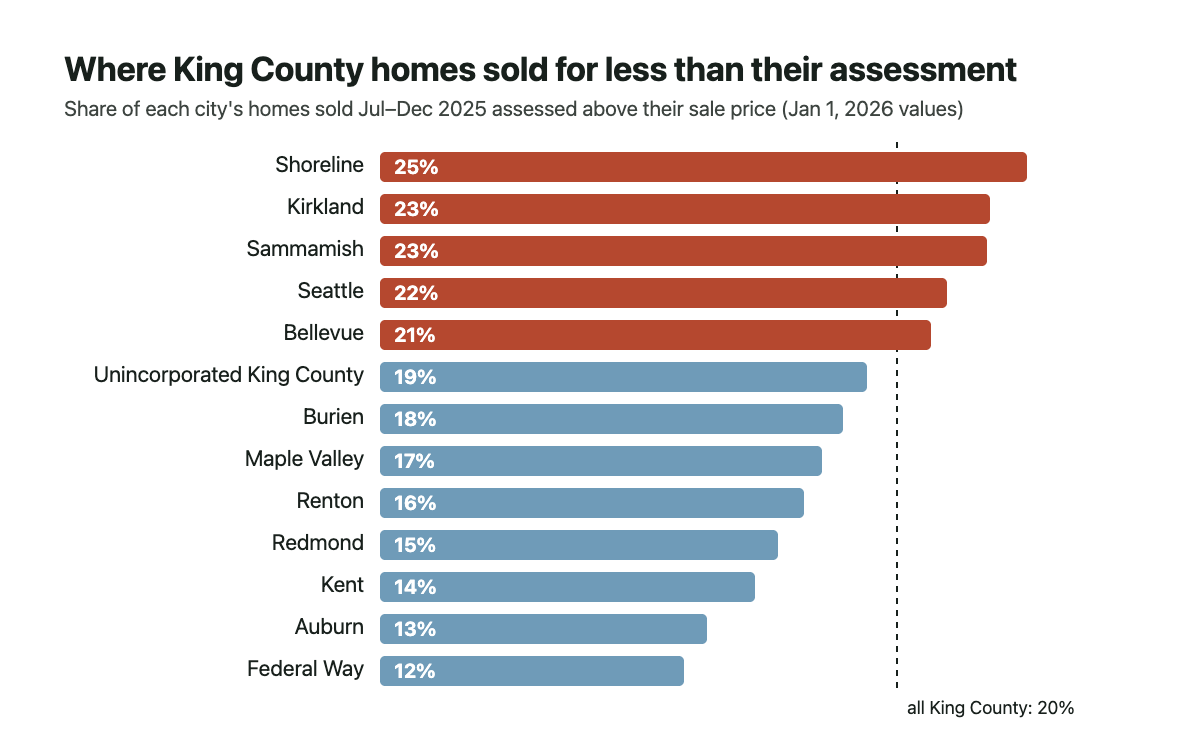
- About one in five (20%) of these homes was assessed above its sale price, and about one in ten was assessed at least 5% above it.
- North and the Eastside run highest: Shoreline 25%, Kirkland 23%, Sammamish 23%, Seattle 22%, Bellevue 21%.
- South King County runs lowest: Kent 14%, Auburn 13%, Federal Way 12%.
- The typical home still sold for more than its assessment, by about 7 to 8%. Most people are not over-assessed, but those who are tend to be in certain areas.
Why it's uneven
The county revalues entire areas at once using a model based on averages, which can miss places where the market changed differently. In 2025, many higher-priced areas saw flat or softening prices, so values set from the trend sometimes ended up higher than what buyers actually paid. This is my interpretation of the pattern, not something the data proves. The data only shows where it happened.
What this does and doesn't mean
- One sale does not decide the issue. A home might sell for less because it needed repairs, and the Board understands that. What matters is a pattern of similar homes selling below their assessed values.
- This data is only about homes that actually sold. It does not say anything specific about your house, just how often the county's value was higher than real sale prices in your area.
- A lower assessed value changes your share of taxes, but it does not reduce the overall budget. (How that works.)
Check your own
The free check lets you compare your January 1 value to the closest similar sales in your neighborhood. If you received your notice in September, you still have until November to appeal.