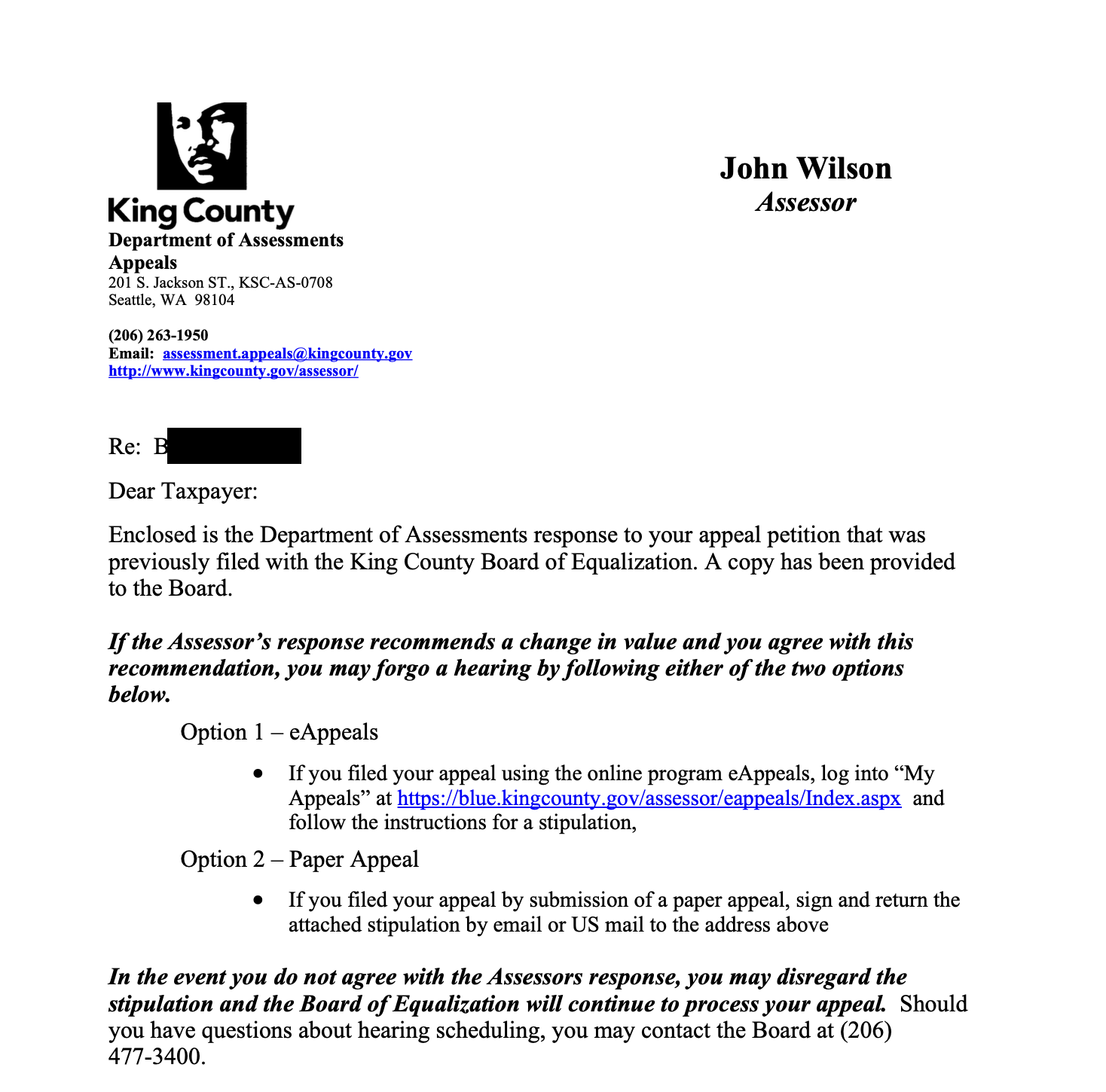
You filed your appeal, felt good for a day, and then probably forgot about it. Weeks later, you get an envelope from the King County Department of Assessments. Inside, you’ll find their response to your petition, a value, and a form. This is the most important mail you’ll get in the whole process, but it’s not always clear what you’re supposed to do next.
Why you got it
Your appeal is sent to the Board of Equalization, not directly to the Assessor. Before the Board reviews your case, the Assessor’s appeals team looks over your petition and sends a response to both you and the Board. According to the Board’s rules, you must get this response at least 21 business days before your hearing. That’s also your deadline for submitting evidence.
The two kinds of answer
- A recommended change in value. The Assessor’s appraiser reviewed your case and agrees that a reduction is justified, though it’s usually less than what you requested. This offer comes with a stipulation, which is an agreement on the new number.
- No change. The Assessor believes the original value is correct, and the response will explain why, often using their own comparable sales.
If they recommend a change
The letter gives you two ways to accept the offer. If you agree, you can skip the hearing.
- If you filed online, log into My Appeals in eAppeals and follow the instructions for the stipulation.
- If you filed on paper, sign the attached stipulation and send it back by email or mail.
If you don’t agree, you don’t have to do anything. As the letter says, "you may disregard the stipulation and the Board of Equalization will continue to process your appeal." Your hearing will stay on the schedule. You can join by phone or let the Board decide based on what you already submitted.
How to decide
Here’s something most people don’t mention: the stipulation shows which part of your case the Assessor thinks would stand up. I used three questions to help me decide:
- How close is their number to your comps? If the recommended value is near the median of your best comparable sales, there may not be much more to gain at a hearing.
- How strong is your evidence, really? In Washington, the Assessor’s value is considered correct unless you can prove otherwise with "clear, cogent and convincing" evidence (RCW 84.40.0301). Solid comps meet that standard. Wishful comps don’t.
- What does a hearing cost you? Prep time, a phone call, and the real chance of walking away with the original value. A sure smaller cut is worth something.
I requested a value of about $1.15 million on a property assessed at $1.4 million. The Assessor recommended around $1.3 million, which was about 5% less. My comps were decent but not outstanding, so I decided to sign. (You can read the full story here.)
If they say no change
Look closely at their comps. A no-change response is the Assessor’s strongest argument, and you’ll hear the same points at the hearing. Check if their sales are truly similar to your home—maybe they’re bigger, newer, on a better street, or sold long before January 1. If you spot differences, bring them up at your hearing. If you don’t find any, you can withdraw your appeal without any penalty.
After a hearing
If you go to the Board, both you and the Assessor will get a written Board Order. The Board says it sends this within 45 days of your hearing. If either side disagrees with the decision, the next step is to appeal to the state Board of Tax Appeals within 30 days.
If you haven’t filed yet, start with the step-by-step guide, and check if your September notice still gives you until November to appeal.