Updated October 9, 2026: I re-measured the results after we improved how the check selects and adjusts comparable sales. Now, it uses homes from the same neighborhood that are truly similar, with sales adjusted to January 1. The main finding is still about 1 in 4 homes, and I’ve added details on what real Board decisions say about which gaps actually win.
Whenever I talk about my own appeal, people always ask if it’s just my situation or if it happens to others too. So, I decided to find out by checking the numbers.
What I did
When I ran this, the site covered about 1.14 million homes across King, Pierce, Snohomish and Clark counties (Kitsap was added on October 10, after this study): houses, townhouses and small multi-unit buildings, not condos or land. I picked 800 at random in each county and ran each one through the exact check you get on the front page: the county’s value as of January 1, 2026, compared with homes in the same neighborhood that sold in 2025 and are truly similar (size within 20%, built within 15 years, same build quality, similar lot), adjusted for size, lot, age and bathrooms.
Here’s something important about the check: out of the five sales most similar to your home, it uses the three with the lowest adjusted prices. This gives owners the strongest fair case. Because this method tends to find more gaps, I also tried using the three most similar sales instead. That approach found fewer over-assessed homes—about 1 in 5 (18.5%), and 12% by 5% or more. For any single home, the real answer is likely somewhere in between, which is why the size of the gap matters more than just whether there is one. I’ll explain more about that below.
One thing to clarify: if a home sold in 2025 for at least its assessed value, I counted it as not over-assessed, no matter what nearby sales showed. The Board would look at that sale first. This adjustment made almost no difference—only 2 to 6 homes per 800.
What I found
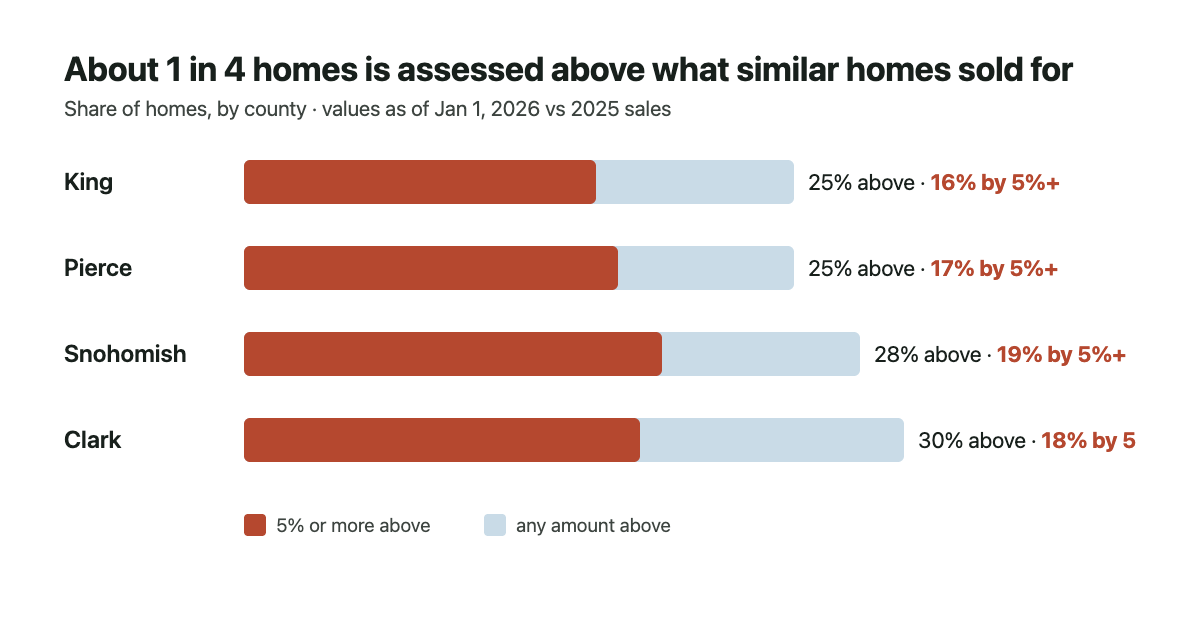
The results were very similar across all four counties, even though they are quite different from each other.
- About 1 in 4 homes (25–30%) are assessed higher than what similar homes in the same neighborhood actually sold for. That adds up to around 300,000 homes.
- About 1 in 6 homes (16–19%) are assessed at least 5% higher than recent sales, which is about 195,000 homes.
- In that 5%-or-more group, the typical gap is 10–14%, worth about $630–$1,300 a year in property tax, depending on the county.
Which gaps actually win: real Board decisions
King County’s Assessor shares the results of every appeal. I looked at 3,826 residential appeals from the last two tax years, ran this check on each home as of its valuation date, and compared the check’s results with what actually happened. If a homeowner settled with the Assessor, I counted that as a win. Most wins happen through settlements before any hearing.
- When the check showed a gap of 10% or more, 47% of those homeowners got a reduction, typically 7–12%.
- If the gap was under 10%, 31% of homeowners got a reduction, which is only slightly higher than the 27% for homes the check called fair.
In Washington, the Assessor’s value is assumed to be correct, and even careful estimates can differ by a few percent. Small gaps fall within that margin of error. That’s why the check now considers a gap of 10% or more a strong case, and anything less a weak one. For smaller gaps, it’s only worth appealing if you have extra evidence, like repair bids, defects, or mistakes in your record. These results are for King County only; I don’t have outcome data for the other three counties yet.
What this doesn’t tell you
- This is just an estimate, not a full appraisal. Mass-appraisal models can miss details about individual homes, and so can any quick comparison, including this one.
- This doesn’t mean the county did a poor job. When you value a million homes each year with a model, some will always be off in either direction. That’s why the appeal process exists.
- This isn’t a guarantee that you’ll win. The Board numbers above show what happened for people who appealed, but your outcome depends on your own evidence.
- Lowering your assessed value changes your share of the tax, but it doesn’t reduce the overall budget. In Washington, levies are based on the total budget, so a reduction usually just means you stop paying part of your neighbors’ share. (More on how that works.)
Check your own
The check is free and takes about ten seconds for homes in King, Pierce, Snohomish, Clark, and now Kitsap counties. Your deadline is July 1, or 60 days after your value notice was mailed—whichever is later—so be sure to check the date on your notice. If your gap is 10% or more, the step-by-step guide will walk you through what to do next.